Portfolio

Young Scholars Initiative

The Young Scholars Initiative is a community of social science researchers associated with the Institute for New Economic Thinking. They used VisionMaps to organize their online conference in 2020. Over a period of 10 days, they used the software to discuss the 100 most important questions of our time, not specifically for their organization, to establish a research agenda for economists in their community.

They received questions for the first deployment of the VisionMap software from Nobel laureates, global leaders, and even his holiness Pope Francis!

The YSI Virtual Plenary 2020

"New Economic Questions", 6–15 November 2020. Ten days, around the clock, inside a virtual sea with a lighthouse, 21 working group ships, a social island and a sky of questions. The two-minute film below shows what it was like.

10,000young scholars took part
220+sessions in ten days
30keynote speakers
80+mentors
21working group ships
12,730hours of stream watched

A world to explore

The plenary site has been brought back to life. Open it, sail to a ship, step into a constellation and browse the questions exactly as the participants did.
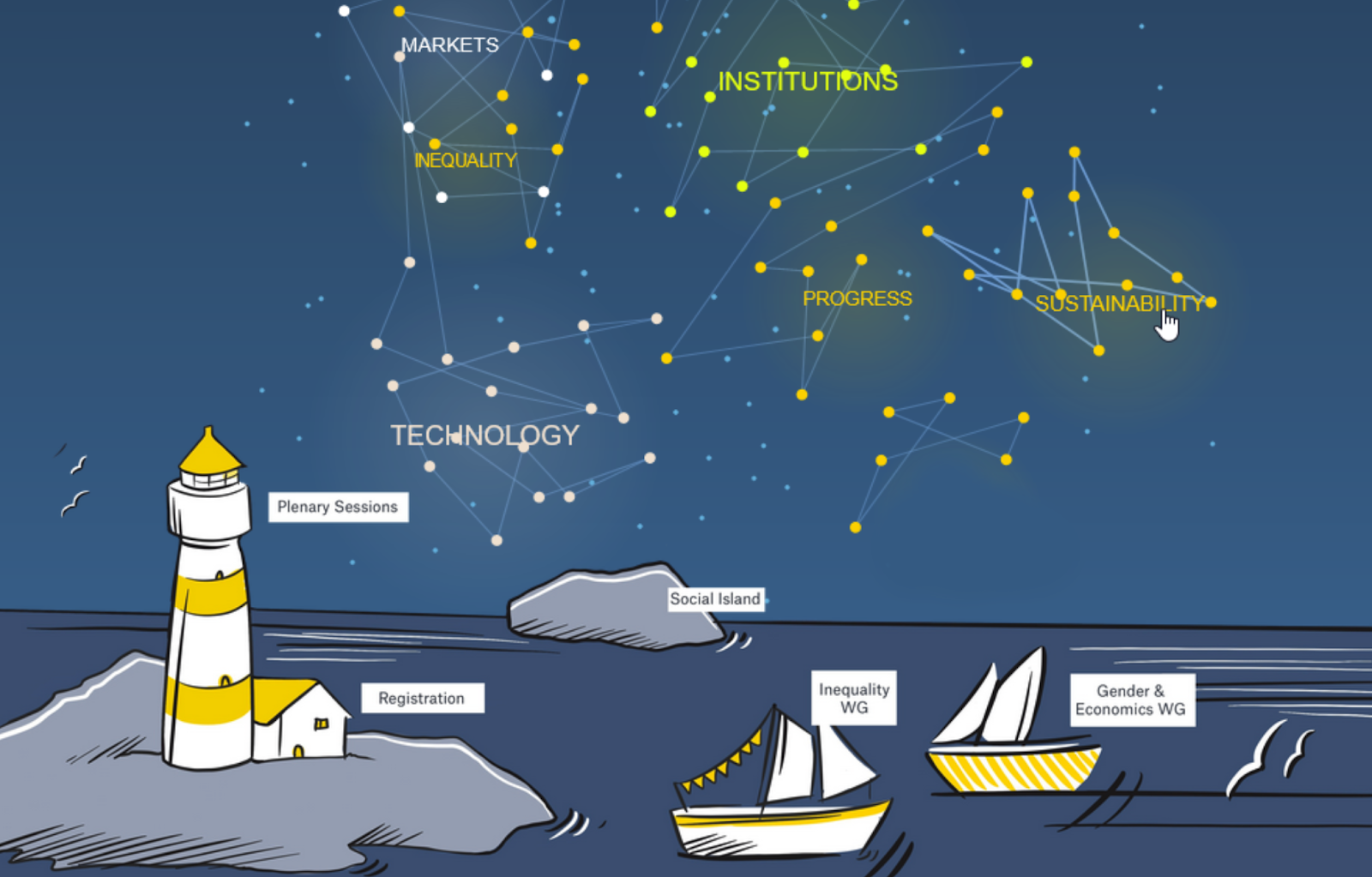
Concept art of the plenary sea
The 2020 concept: lighthouse, ships, social island and the question sky
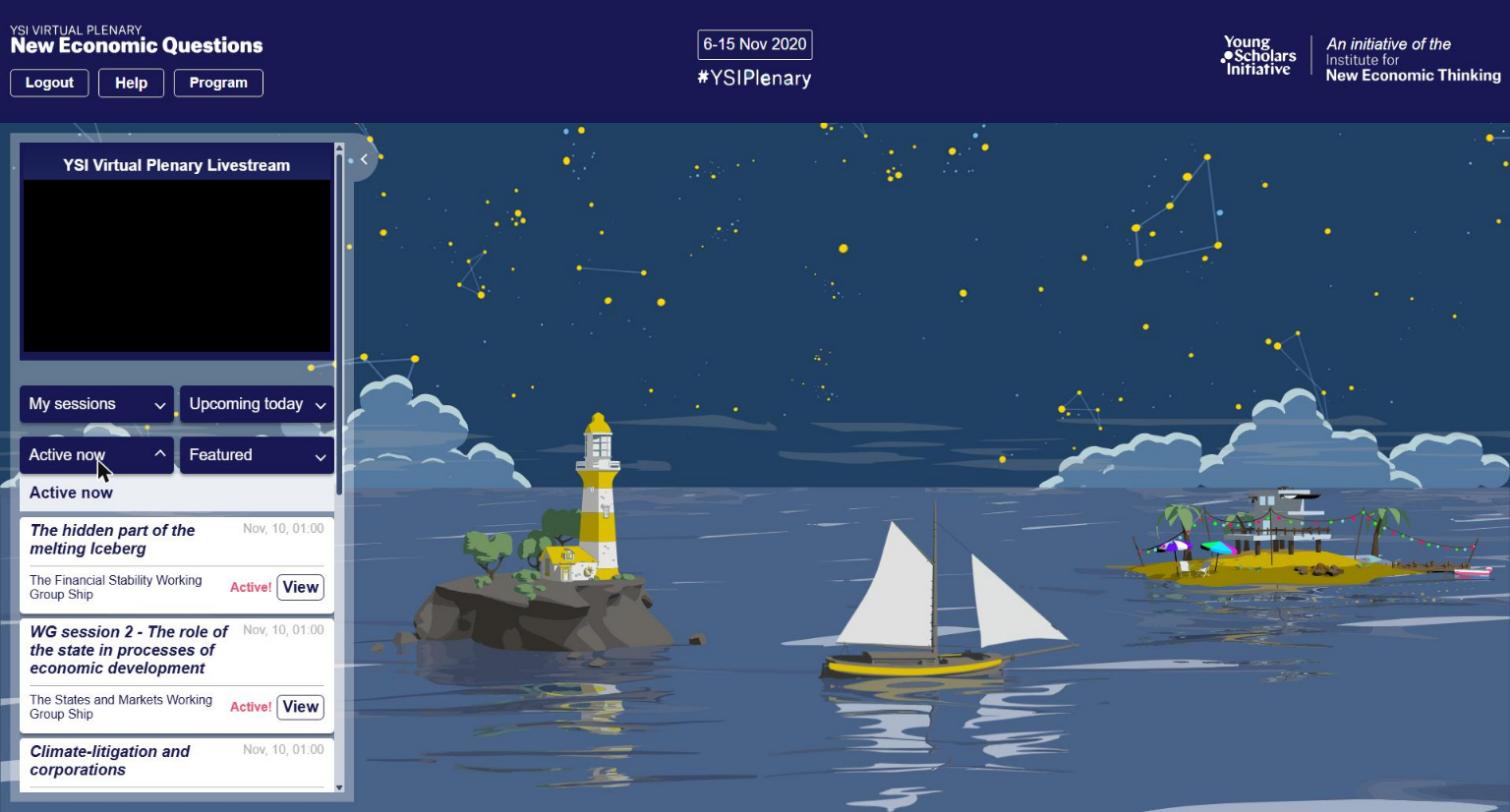
Plenary home
The sea, as participants saw it on 10 November 2020
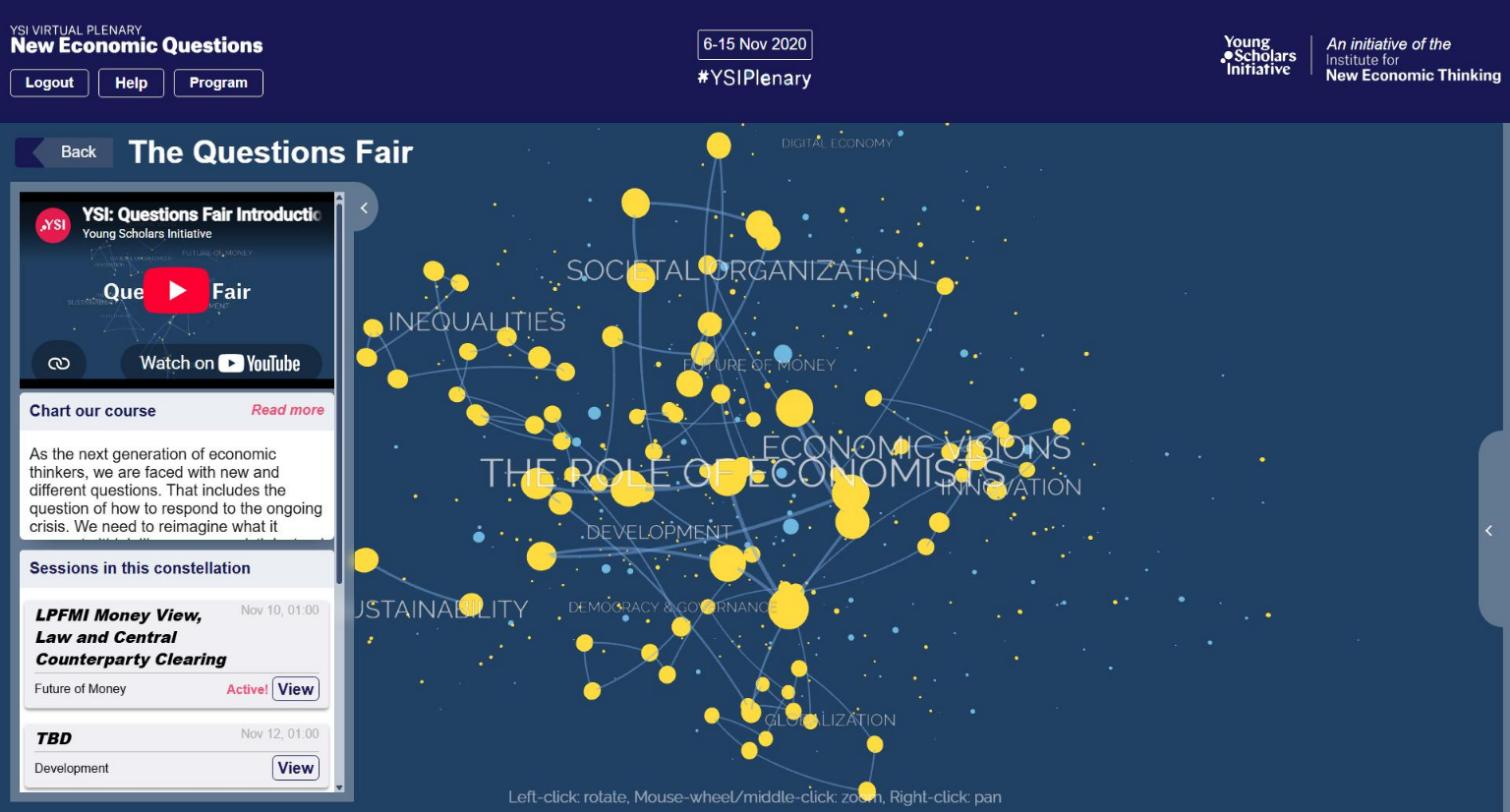
Questions Fair
The Questions Fair: every star is a question
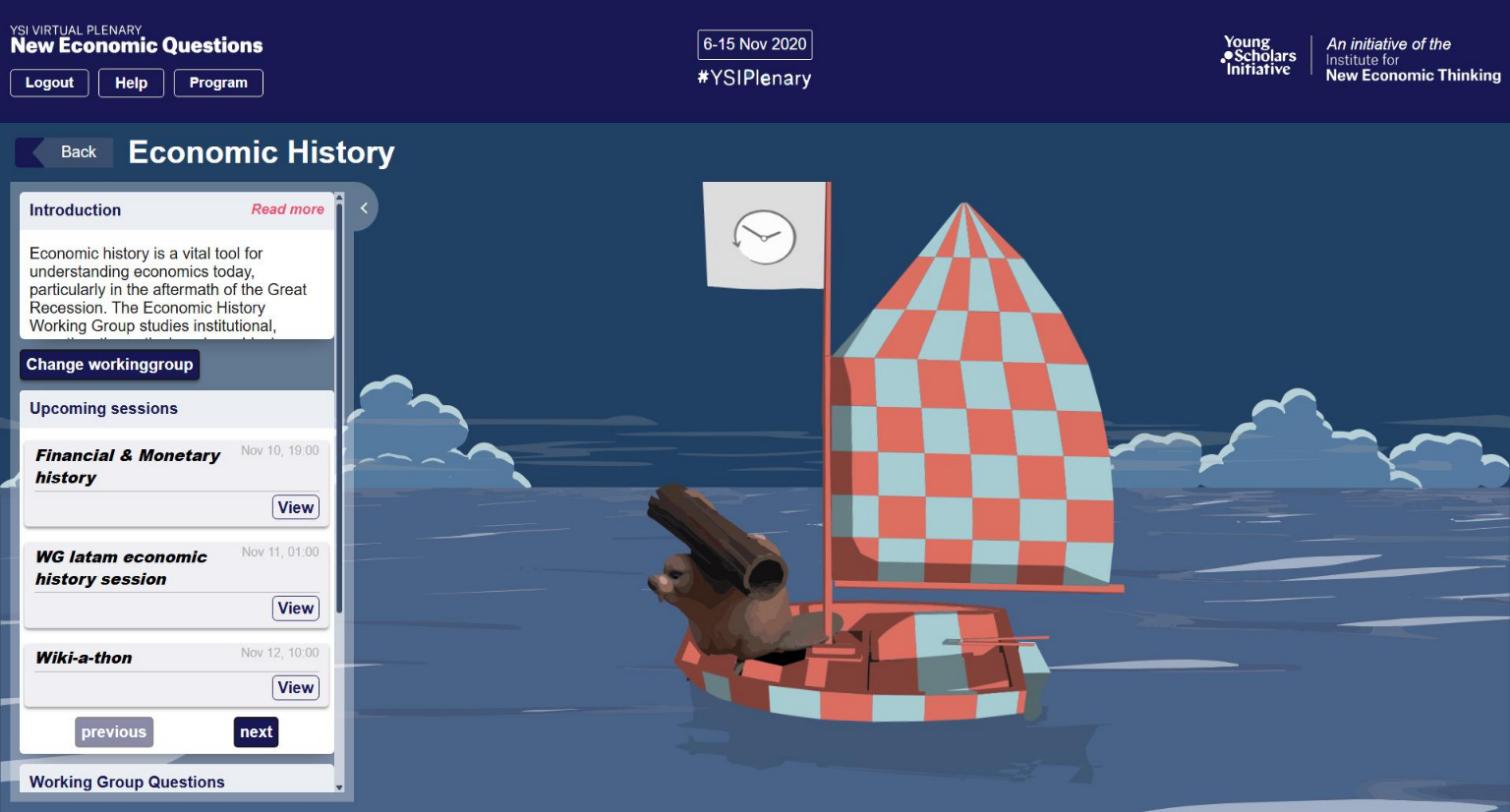
Working group ship
A working group ship with its track of sessions

The 100 questions

The questions that came out as most popular at the conclusion of the plenary, grouped by the constellation they belonged to. Featured questions carry the name of the speaker who put them forward.

Recovered from the YSI website as archived in May 2021; 98 of the 100 entries survived.

Economic Visions

  1. What place does the current economic system give to uselessness, that is, to beauty? — His Holiness Pope Francis
  2. What will be the economic role of the state over the next century? — Mervyn King
  3. How can we ensure that the political dimensions of economics are not obscured?
  4. How do we cope with unquantifiable uncertainty? — Mervyn King
  5. As a practical matter, how can Democratic open societies like the US and the EU cooperate with repressive regimes on global problems like climate change and infectious diseases that require global cooperation? — George Soros
  6. What is the most important ethical / moral issue for economics to address?
  7. Why are the BigTechs the winners of the Pandemic?
  8. What are the alternatives to GDP for measuring economic performance?
  9. What is economics role in climate change mitigation?
  10. What are the ethical challenges that we need to rework on to succeed as economists? — Yanis Varoufakis
  11. How should economics address global power imbalances?
  12. What is the role of narratives in economic decisions and behaviour? — Behavior and Society Working Group
  13. Where do economic preferences come from? and what are they?
  14. How can we propose economic assumptions that better reflect reality?
  15. Is human behavior rational or reasonable?
  16. What property arrangements foster a sustainable approach to economic development better than private property?

The Role Of Economists

  1. How do we make economics, and economies, truly inclusive? — Julie Nelson
  2. How can we frame a model of development that is more people oriented rather than goods oriented?
  3. Recognizing the biases implicit mainstream economic thought, how can we build a better discipline of economics? — Julie Nelson
  4. How can economics incorporate insights from other disciplines?
  5. What is value?
  6. How can economists pretend to know what the future looks like when it depends on decisions that have not yet been taken? — George Soros
  7. What could be the core idea of economics in the 21 century, that is, beyond the allocation of scarce resources?
  8. What are the social implications of data mining?
  9. How can we account for the influence of power in economic analysis?
  10. Efficiency serves as the main target dimension in economics. How to best broaden the normative lense in Econ analysis? — Jakob Kapeller
  11. What is the role of economists in society?
  12. What new roles could economists play?
  13. What should and shouldn't be included when we speak of "the economy"?
  14. How should we define work?
  15. How has neoclassical economics influenced the way people think and behave?
  16. Keynes said increasingly only economists determine what future will be possible for youth as the next generation -indeed possibilities are exponentially locked in- so why do so few people teach economics as designing future instead of extracting money?
  17. How does the notion of the utility maximizing rational agent work as ideology justifying unregulated markets and their results?
  18. Do economists need to have a shared conception of the ultimate ends of economics?
  19. How to save the climate without causing further distributional asymmetries and restricting individual freedom? — Jakob Kapeller

Societal Organization

  1. Can economic systems (of production, consumption, and distribution) be fundamentally just? How can we design and maintain a sustainable and non-violent transition to a fairer economic system?
  2. If the origin of the word economy refers to the administration of household goods, one might ask: who today administers the goods of our Common Home? What bond unites those who administer those assets and those whose assets are administered? — His Holiness Pope Francis
  3. Can economists assure us that the future will be orderly and controllable when humans are fallible and people try to understand the world and change it to their advantage at the same time? — George Soros
  4. Taking into account that the administration of household goods requires its rules, its laws: what could be those laws that put the economy at the service of fragility? What should the relationship between economics and politics be like to ensure that everyone has what is necessary to live a fulfilling life? — His Holiness Pope Francis
  5. What is the connection between the deepening inequality of recent decades and the growing prominence of the meritocratic belief that the winners deserve their success? — Michael Sandel
  6. If chances were truly equal and markets were perfectly competitive, would market outcomes reflect what people deserve? If not by markets, how can we determine the value of a person's contribution to the common good? — Michael Sandel
  7. If chances were truly equal and markets were perfectly competitive, would market outcomes reflect what people deserve? If not by markets, how can we determine the value of a person's contribution to the common good? — Michael Sandel
  8. What is the connection between the deepening inequality of recent decades and the growing prominence of the meritocratic belief that the winners deserve their success? — Michael Sandel
  9. How should we reconceive economics considering its earlier conception of economics not as value neutral but engaged in moral and political philosophy?

Innovation

  1. How do we steer economies towards value creation and away from value extraction? — Mariana Mazzucato
  2. What kind of welfare state do we need for the post-pandemic world?
  3. How can we make sure that technological and scientific development has equitable social impact?
  4. What is required to achieve the collective action needed to tackle the global challenge of climate change?
  5. How might developing countries position themselves to reach for new technological frontiers, rather than to catch up to current ones?
  6. What capacity do developing countries have for implementing industrial and innovation policies?
  7. How can firms innovate themselves to survive in the post pandemic era?
  8. How can we explain the mismatch between strong digital innovations and sluggish growth?
  9. What is public value? — Mariana Mazzucato
  10. How can we effectively construct micro foundations that effectively reflect the heterogeneity of market participants? — Bill Janeway
  11. Market capitalism and representative democracy: can they be married? — Bill Janeway
  12. How is the theory of the innovative firm linked to the global capital accumulation trends?
  13. How do we bring public purpose to the centre of policy making? — Mariana Mazzucato
  14. How do we put innovation at the centre of the welfare state? — Mariana Mazzucato
  15. How do we put inclusive growth at the centre of a new social compact - so that we don’t have the rely so much on redistribution? — Mariana Mazzucato
  16. How do distributional issues affect macro models and policy and how are they usefully incorporated into micro models? — Bill Janeway

Development

  1. How can economics address issues of intersecting inequalities? (Class, gender, race, caste, ethnicity, local/migrant) — Jayati Ghosh
  2. Is industrialisation a necessary step for economic development?
  3. How can we include socio-cultural diversity into economic models of development?
  4. How could industrial policy help developing countries in the 21st century?
  5. How do the institutions of a country affect the path of economic development?
  6. Given power imbalances and elite pushback, can global economic relations enable equitable and sustainable development? — Jayati Ghosh
  7. How could financial systems be modified to help achieve the needs of more sustainable and inclusive economies ? — Stephany Griffith-Jones
  8. Why are some regions more resillient towards economic crisis than others?

Sustainability

  1. Could economists and young scholars participate in the creation of a new economic model, and implement it as a cryptocurrency? Could a decentralized value system be resilient enough to withstand political and financial efforts to maintain status quo?
  2. Are economic growth and sustainability mutually exclusive?
  3. How can we finance the green transisition?
  4. Must economics generalize? Beyond the data, can economics develop theories and/or methods specific to time and place? — Geoff Mann
  5. How are climate change mitigation and adaptation measures perceived by different social groups?

Globalization

  1. To what extent is the discipline of economics a part of the problem itself?
  2. What are the implications of structural differences between developing and developed countries for economic theories? — Justin Yifu Lin
  3. What is the appropriate role of state in the process of economic development and transition in a market economy ? — Justin Yifu Lin
  4. Which parts of the global economy will continue to globalize, which will deglobalize?
  5. How do health (physical and mental) and other forms of well-being impact civic engagement, trust in institutions, and voting patterns? — Shannon Monnat

Future Of Money

  1. How will CBDC (central bank digital currencies) affect monetary economics (or the future of money or nature of money)?
  2. How could financial systems be modified to help achieve the needs of more sustainable and inclusive economies? — Stephany Griffith-Jones
  3. What's the future of work if machines can produce most goods and services; what follows for jobs and inequality? — Lord Adair Turner
  4. Does trying to combine economics and ethics improve economics or merely worsen ethics? — Gonçalo Fonseca
  5. Should public development banks have bigger roles; how could they serve well transition to low carbon and fair economy? — Stephany Griffith-Jones
  6. Have we solved the 'economic' problem which Keynes anticipated, that is, could we all in principle live a life of leisure?
  7. How should productivity be measured?
  8. What is money?

Democracy & Governance

  1. Can democracy survive global capitalism? — Martin Wolf
  2. How can we handle AI responsibly?
  3. To what extent the crisis of democracy is a consequence of capitalism's inequalities?
  4. Why is there a relative scarcity of female economists? — Goncalo Fonseca

Inequalities

  1. Do free markets always lead to concentration of wealth?
  2. Why did the Covid-19 pandemic exaccerbate inequality within countries?
  3. How can we overcome the polarising and concentrating tendencies of the digital economy to address or alleviate inequality?
  4. How do we understand the relationship between power and wealth, and might it be the key to alleviating inequality?
  5. Is the conflict between capital and labour the main driver of wealth inequality?
  6. Covid is making countries pile on new debts that increase inequality. How to get "quantitative easing for people"? — Thomas Ferguson

Digital Economy

  1. Will the China US rivalry fundamentally change the way the world and the global system functions, and if so, with what consequences. — Michael Spence
  2. How can new technologies be employed towards social progress?